Key Takeaway
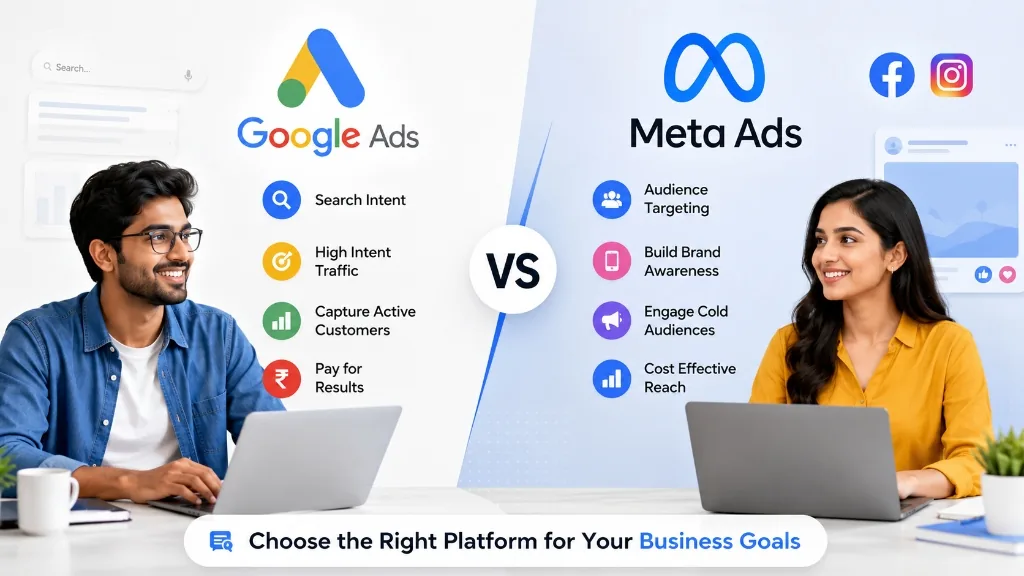
Google Ads captures people who are already searching for your product or service, while Meta Ads introduces your business to people who do not know you yet. The right platform depends on your goal - but the smartest businesses use both together for maximum impact.
Choosing the right advertising platform can make a significant difference in how quickly your business attracts customers and generates sales. Two of the most powerful options today are Google Ads and Meta Ads - but they work in fundamentally different ways.
Understanding these differences is the key to spending your ad budget where it will actually move the needle for your business.
Google Ads vs Meta Ads: At a Glance
| Feature | Google Ads | Meta Ads |
|---|---|---|
| Primary Strength | Capturing existing demand | Building awareness & discovery |
| Targeting Method | Keywords & search intent | Demographics, interests & behavior |
| Best For | Services, local businesses, high-intent searches | E-commerce, visual products, brand building |
| Ad Formats | Search, Display, Shopping, YouTube | Image, Video, Reels, Stories, Carousel |
| Lead Quality | High intent, ready to convert | Broader reach, requires nurturing |
1. Google Ads Is Ideal for High-Intent Customers
The biggest advantage of Google Ads is search intent. When someone types "best digital marketing agency," "web designer near me," or "buy running shoes online," they already have a specific need - and they are ready to act.
Google Ads allows your business to appear at that exact moment. This makes it especially effective for:
- Local service businesses - plumbers, clinics, lawyers, repair services
- Professional services - marketing agencies, consultants, accountants
- E-commerce products with strong search demand
- Emergency or time-sensitive services
2. Meta Ads Are Excellent for Building Awareness
Meta Ads work differently. Instead of waiting for people to search, you proactively introduce your business to people who are likely to be interested - even before they know they need you.
Facebook and Instagram advertising work best for:
- Building brand awareness and recognition
- Launching new products or services
- Growing a targeted social media audience
- Retargeting website visitors and past customers
- Promoting visually appealing products - fashion, food, fitness, home décor
For businesses that depend on branding, lifestyle imagery, or creative storytelling, Meta Ads can be a powerful way to capture attention and drive discovery.
3. Consider Where Your Customers Are
Your ideal customer's behaviour should guide your platform choice.
Ask Yourself:
Does your audience search Google when they need your product? → Start with Google Ads.
Does your audience discover brands while scrolling Instagram or Facebook? → Start with Meta Ads.
4. Google Ads for Lead Generation
Google Ads performs particularly well when your goal is generating leads from people with an existing, active need. Industries that see strong results include:
- Real estate & property services
- Legal & financial services
- Healthcare & clinics
- Home improvement & renovation
- Digital marketing agencies
Success depends on choosing the right keywords, creating high-converting landing pages, and consistently optimizing campaigns based on real data.
5. Meta Ads for E-Commerce & Visual Products
If your product looks great in photos or videos, Meta Ads give you the creative canvas to showcase it. Instagram Reels, Facebook carousel ads, and Stories allow brands to tell a story that search ads simply cannot.
Meta Ads also excel at retargeting - showing your ads to people who visited your website, viewed your products, or engaged with your social content - keeping your brand visible throughout the customer's buying journey.
6. Budget & Goals: Choose What Fits Your Objective
Both platforms can work with different budgets. The right choice is driven by what you want to achieve:
- Choose Google Ads when your goal is capturing existing demand and driving immediate conversions.
- Choose Meta Ads when your goal is reaching new audiences, building awareness, or creating demand for your product.
7. The Best Strategy: Use Both Together
You don't always have to choose one. In many cases, combining both platforms creates the most powerful digital advertising strategy:
- Meta Ads introduce your brand to a cold audience
- Google Ads capture people who later search for your business or service
- Retargeting on both platforms brings interested visitors back to convert
This covers every stage of the customer journey - from brand discovery, to research, to purchase - giving your business the best possible return on every rupee spent.
Frequently Asked Questions
Is Google Ads better than Meta Ads?
Neither is universally better. Google Ads excels at capturing existing demand, while Meta Ads is stronger for building awareness and reaching cold audiences. The best choice depends on your business goals and where your customers spend their time.
Which platform has a lower cost per lead?
Meta Ads often have a lower cost per click, but Google Ads typically deliver higher-intent leads that convert at a higher rate. The actual cost per lead depends on your industry, targeting, ad quality, and landing page performance.
Can I run Google Ads and Meta Ads at the same time?
Yes, and many successful businesses do. A combined strategy lets Meta Ads build awareness while Google Ads captures people who later search for your brand or service. Retargeting can then re-engage visitors across both platforms.
How can Growell Marketing help with paid advertising?
Our Paid Advertising Services cover both Google Ads and Meta Ads - from campaign strategy and creative production to ongoing optimization and conversion tracking. We help you invest your budget where it generates the highest return.