Key Takeaway
Content creation becomes stressful when you try to decide what to write on the day you need to publish. By decoupling editorial planning from writing and batching 30 days of high-intent topics in one structured session, you build an unstoppable compounding SEO engine.
Ask most founders and marketing managers about their biggest content struggle, and you will usually hear: "We know we need to post consistently, but we never have enough time to figure out what to write."
They sit down on a Wednesday morning, stare at a blank Google Doc for 45 minutes, write a generic 600-word post in a rush, hit publish, and wonder why nobody inquires.
At Growell Marketing, we do not brainstorm topics daily. Instead, we use a single 3-hour afternoon sprint once a month to research, validate, and schedule all content across SEO, social media, and newsletters.
Here is the exact 6-step repeatable framework you can use to plan an entire month of high-converting content in a single afternoon.
Step 1: Review Past 30-Day Conversion Data (30 Mins)
Never plan next month's content in a vacuum. Start by reviewing what generated real business results over the last 30 to 60 days.
Log into Google Search Console and Google Analytics to answer:
- Which articles generated the most organic goal conversions & contact inquiries?
- Which queries are ranking in positions 4 through 15 (low-hanging fruit ready to hit page 1)?
- Which recent client sales calls raised recurring objections or misunderstandings?
Doubling down on topics that already proven to drive leads is 10x more profitable than guessing new random ideas.
Step 2: Define the Monthly "Hero Theme" (20 Mins)
Instead of publishing five completely unrelated topics (e.g., one on TikTok ads, one on web design, one on hiring, and one on local SEO), choose one overarching commercial theme for the month.
For example, if your agency wants to push SEO Services next month, your monthly theme becomes "Organic Search & Pipeline Growth."
All four weekly blog articles, supporting social carousels, and client email broadcasts will revolve around different angles of this single theme. This establishes intense topical focus and drives maximum authority.
Step 3: Map Topics Across the Full Customer Funnel (40 Mins)
A month of high-converting content must cater to buyers at every stage of awareness. We allocate our 4 monthly long-form articles using our Funnel Balance Formula:
Week 1: TOFU (Awareness)
Comprehensive educational guide solving a major symptom. (e.g., "Why Website Traffic Drops")
Week 2: MOFU (Evaluation)
Strategy comparison or framework breakdown. (e.g., "Agency vs In-House SEO Cost Breakdown")
Week 3: MOFU (Case Study)
Real client data breakdown with verified metrics and ROI teardown.
Week 4: BOFU (Decision)
High-intent solution checklist or audit offer with frictionless CTA.
Step 4: Conduct Rapid Keyword & Intent Verification (30 Mins)
Before locking in the titles, run quick searches on Google to verify search intent:
- Inspect the top 3 ranking results: Are they listicles, guides, or landing pages?
- Review "People Also Ask" boxes to extract 4–6 mandatory subheadings.
- Identify high-volume long-tail modifier keywords to naturally integrate into H2s and H3s.
Step 5: Pre-Assign Next-Step Conversion Offers (20 Mins)
Every article must have a pre-assigned conversion goal before writing begins. Never leave the CTA as an afterthought.
The CTA Rule of Thumb:
If you cannot clearly answer "Where does the reader go after finishing this sentence?", the topic is not ready to be scheduled. Connect each post to either a downloadable lead magnet, a related service page, or a free audit booking form.
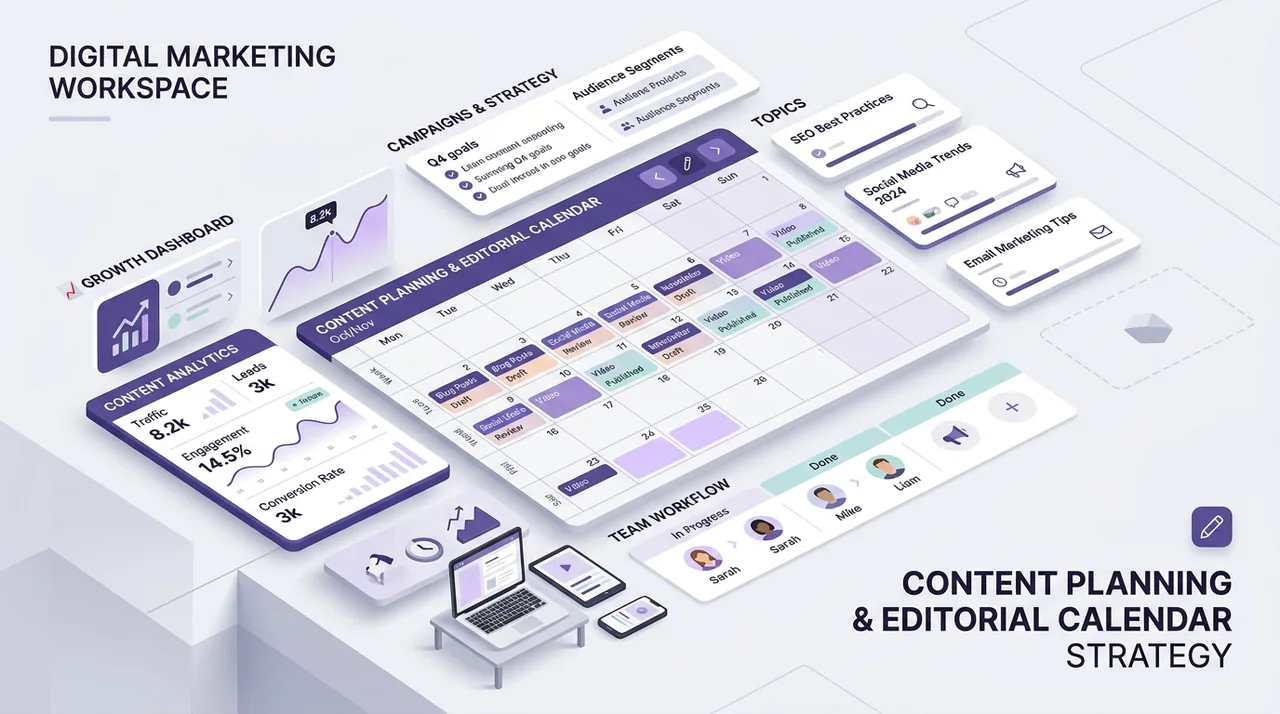
Step 6: Populate the Production Calendar (20 Mins)
Lock your topics into a structured editorial roadmap with assigned publishing dates, authors, target keywords, and featured image requirements.
Frequently Asked Questions
What is content batching and why is it faster?
Content batching is the process of grouping similar production tasks into dedicated time windows. By spending 3 uninterrupted hours researching and outlining all monthly articles, you eliminate the daily context switching cost and produce significantly higher quality work in half the time.
How many blog articles should a small business publish monthly?
Quality consistently outperforms quantity. For most growing businesses, publishing 2 to 4 in-depth, authoritative guides per month is far more impactful for Google rankings than publishing 15 rushed, low-value posts.
How do I repurpose these monthly blog posts across social media?
Each long-form pillar article can easily be extracted into 3 LinkedIn text posts, 2 Instagram carousels, 1 short-form video script, and 1 newsletter highlight, giving you 20+ social assets from just 4 monthly articles.